Sciatica in Boulder has a way of showing up right when you can least afford it — mid-commute on Broadway, three miles into a trail run up Mount Sanitas, or halfway through a long meeting downtown. That shooting, burning pain runs from your low back down through the buttock and leg, and suddenly sitting through a workday, driving up to the mountains, or sleeping through the night all become something to negotiate. Painkillers can buy you a quiet hour. They do not touch whatever is actually pressing on the nerve.
At MŪV Chiropractic we treat sciatica as a signal, not the problem itself. Something along that nerve’s path — the low back, the pelvis, a muscle deep in the hip — is irritating it. Find that source and calm it down, and the leg pain usually has room to ease.
What sciatica actually is
The sciatic nerve is the longest and thickest nerve in your body. It forms from several nerve roots in your lower spine, runs behind your hip, passes near (and sometimes through) the piriformis muscle in your buttock, then travels down the back of your leg all the way to your foot. Sciatica is not a diagnosis in itself — it is the name for the pain, tingling, or weakness that shows up when something along that path is irritating or compressing the nerve. That distinction matters. Treating “sciatica” without finding what is actually squeezing the nerve is a bit like turning off a smoke alarm without checking for fire.
What it feels like
Sciatica rarely feels the same for two people, but a few patterns come up again and again in our Boulder office:
- Shooting or burning pain. A sharp, electric jolt or a deep burn that travels from your low back or buttock down the back or side of one leg.
- Pins and needles. A tingling, prickling sensation anywhere along the nerve’s path, often reaching the calf or foot.
- Numbness or weakness. A leg or foot that feels dulled, heavy, or harder to lift, push off with, or control on stairs.
- Worse with sitting. Pain that builds after a long drive, a stretch at a desk, or settling into a low couch.
- Pain that shifts. Discomfort that moves from the low back into the leg, or eases in the back only to intensify further down the leg.
- Trouble finding a comfortable position. Standing, sitting, and lying down all seem to aggravate something different.
What’s actually causing it
Sciatica is almost always downstream of something else. A herniated or bulging disc pressing on a nerve root is one of the most common drivers, especially after a period of heavy lifting, a long drive, or simply years of desk work catching up with you. Degenerative changes and bone spurs can narrow the space where the nerve exits the spine, a condition called spinal stenosis. Deep in the hip, a tight or overworked piriformis muscle can squeeze the nerve as it passes beneath or through it, a pattern we see often in runners on Boulder’s trails and cyclists logging miles up the canyons. Pregnancy, prior injuries, and general joint stiffness in the low back and pelvis can all add pressure to the mix.
What ties these causes together is the idea that the sciatic nerve rarely acts alone. Your low back, pelvis, and hips work as one connected chain. When one link in that chain stops moving well, the nerve is often the part that pays for it. That is why we spend real time figuring out where the pressure is coming from rather than only chasing the leg pain.
Why it keeps coming back
Rest can quiet a flare-up for a day or two, and over-the-counter medication can dull the edge, but neither one changes what is actually pinching the nerve. The moment you go back to sitting, driving, or lifting the way you always have, the same structures are still under the same load, and the pain has a way of finding you again. Chiropractic adjustments aim at a different target: restoring motion to the joints in the low back and pelvis that have stopped moving the way they should, so the disc, the nerve root, and the surrounding muscles are no longer stuck taking on more than their share. It is less about chasing the pain down the leg and more about giving the whole region room to move evenly again.
How We Treat Sciatica
Here’s what we often reach for with sciatica:
-
Spinal decompression. A slow, gentle stretch that opens up space in the low back so the disc and nerve stop getting squeezed
-
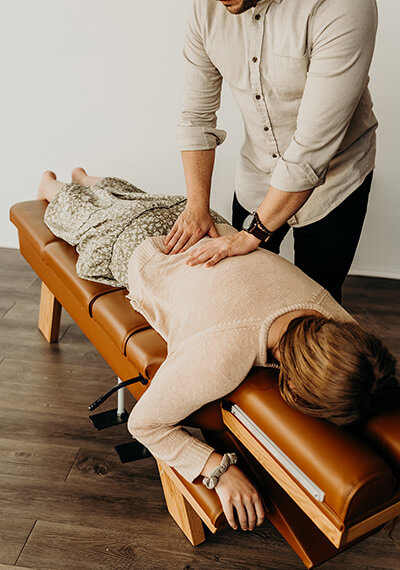
Chiropractic adjustments. Hands-on work through the low back and pelvis that gets your spine moving again and takes pressure off the irritated nerve
-
SoftWave® therapy. Acoustic wave therapy that drives circulation and repair into the irritated tissue along the nerve’s path
-
Soft-tissue work. Hands-on release for tight muscles, including the piriformis, that can pinch the nerve as it passes through
-
Corrective exercise. A step-by-step plan that rebuilds the movement habits driving the problem so it stops coming back
What to expect at your first visit
To start, we talk through your sciatica in detail — when the pain began, what makes it better or worse, whether it’s changed over time, and what you’re hoping to get back to, whether that’s a full night’s sleep or a long run on the Boulder Creek Path. From there we do a hands-on exam to see how your low back, hips, and legs are moving, and we use imaging when it actually helps clarify what’s going on, not as a routine step. Once we have a clearer picture, we build a plan around what’s compressing the nerve and the joints feeding into it, then adjust that plan as you progress. You can read more about what the whole process looks like on our what to expect page, and new patients can start with our $99 New Patient Special, which includes an exam and consultation.
What you can do at home
A few habits tend to help alongside care, though none of them replace finding and addressing the actual source of the compression:
- Move in small doses. Short, frequent walks usually beat long stretches of sitting or lying still.
- Break up sitting. Stand or shift position every 30 to 45 minutes, especially at a desk or on a long drive.
- Check your workstation. A chair that supports your low back and a monitor at eye level take some of the strain off the spine.
- Stay hydrated. Discs rely on fluid to stay cushioned, and general hydration supports that.
- Load gradually. When you’re ready to get back to hiking, skiing, or lifting, build back up rather than jumping straight to where you left off.
If you ever notice loss of bladder or bowel control, progressive weakness in the leg, or numbness in the saddle area, treat that as urgent and see a physician right away. Those are red flags that go beyond what chiropractic care addresses on its own.
Frequently Asked Questions about Sciatica in Boulder
Many people with sciatica find that chiropractic care, including spinal decompression and adjustments, helps ease the pressure that’s irritating the nerve. Results vary depending on the underlying cause, which is why we start with an exam rather than a one-size-fits-all plan.
It depends on what’s driving it and how long it’s been going on, but most people notice some shift within the first few weeks of consistent care. We’ll check in regularly and adjust the plan based on how you’re actually responding.
No referral is needed to be seen. We’ll examine you first and only recommend imaging when it will actually change or clarify the plan, not as an automatic step.
For most people, yes, but it depends on the cause and severity of your symptoms. That’s exactly why the exam comes before any hands-on care — so we know what we’re working with and can rule out anything that needs a different kind of attention first.
Both are tools we reach for here — SoftWave® therapy and hands-on soft-tissue work can each help when a tight piriformis or surrounding muscle is contributing to the nerve irritation, often alongside adjustments and decompression rather than instead of them.
New patients can get started with the $99 New Patient Special, which rolls your consultation and sciatica exam into one visit so we can locate what’s compressing the nerve before you commit to a longer plan.
You don’t have to keep working around sciatica. If it’s been running your schedule long enough, let’s find out what’s actually pressing on that nerve and build a plan to take the pressure off. Book an appointment today, or take advantage of our $99 New Patient Special to get started.

 See all on Google