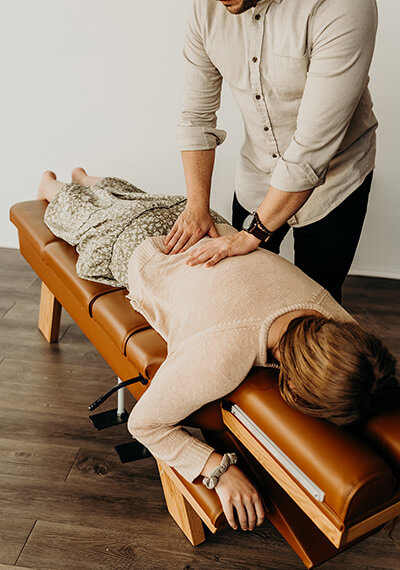
Low back pain in Boulder, CO has a way of touching everything. Sitting through a workday, loading the car, a hike toward the Flatirons, even standing at the sink starts to feel like something you have to brace for. Maybe it started after a weekend trail run, maybe after a long day hunched over a laptop, or maybe you can’t point to a single moment at all. It just showed up and settled in.
When it keeps flaring, reaching for another round of pills starts to feel less like a fix and more like a routine. At MŪV Chiropractic, we treat the low back as part of a moving system, not a single sore spot. That’s often why it keeps coming back.
What’s going on in your low back
Your lumbar spine is built to carry most of your upper-body weight while still letting you bend, twist, and rotate. That combination of load and mobility means it takes on a lot of strain, and a lot of things can go wrong along the way. The lumbar spine is made up of stacked vertebrae, cushioning discs between them, small facet joints that guide movement, and a dense web of muscles and ligaments holding it all together. Pain can come from any one of these structures, or from several at once, which is part of why low back pain can feel so different from one person to the next.
Sometimes it’s a facet joint that’s become stiff and irritated. Sometimes it’s a disc that’s lost some of its cushioning and is pressing on a nearby nerve. Sometimes it’s the sacroiliac joint, where your spine meets your pelvis, that’s not moving the way it should. And often it’s a combination, where one area compensates for another until the whole system feels tight and guarded.
What it feels like
Low back pain shows up differently depending on what’s driving it, but a few patterns are common:
- A dull, deep ache. A steady soreness across the low back that’s worse after sitting or standing too long in one position.
- Sharp pain with certain movements. A catch or jolt when you bend forward, twist, or stand up from a chair.
- Stiffness in the morning. A back that feels locked up for the first several minutes after you get out of bed, then loosens as you move.
- Pain that radiates. Discomfort that travels into a hip, buttock, or down the back of a leg, which can point to a nerve being irritated.
- Muscle tightness or spasm. A band of tension along one or both sides of the spine that seems to guard against certain movements.
- Pain that changes with position. Feeling better lying down or walking, but worse sitting for long stretches, or the reverse.
What’s actually causing it
A lot of low back pain in Boulder traces back to a handful of everyday patterns rather than one dramatic injury. Long hours at a desk, especially with a chair or setup that doesn’t support the natural curve of your spine, load the lower back unevenly hour after hour. Lifting with your back instead of your legs, even once, can strain the muscles and joints enough to set off weeks of discomfort. And this is an active town: hiking the Flatirons, mountain biking, ski days, and trail running all put real demand on the low back, especially when the hips or mid-back aren’t sharing the load the way they should.
That last point matters more than people expect. The low back rarely acts alone. It sits between the hips and the mid-back, and it tends to absorb whatever those neighboring areas can’t handle. Tight hip flexors from sitting all day, a stiff thoracic spine from years of desk work, weak glutes that aren’t doing their share of stabilizing, an old ankle or knee issue that’s changed how you walk: all of it can funnel extra stress into the lumbar spine. Disc irritation, facet joint inflammation, and SI joint dysfunction are often the end result of stress building up somewhere else in the chain, not an isolated problem with the low back itself.
Why rest or pills alone rarely fix it
Rest can calm a flare-up, and medication can take the edge off, but neither one changes what set the pain off in the first place. If a hip that isn’t moving well or a mid-back that’s locked up is still asking the lumbar spine to compensate, the same pattern tends to resurface once you’re back on your feet. That’s why so many people find themselves managing the same low back pain for months or years, each flare feeling a little more familiar than the last.
This is where a whole-chain approach matters. Rather than treating the low back as an isolated sore spot, it helps to look at how the spine, hips, and pelvis are moving together, and address the joints and tissues that are actually driving the strain. Adjustments aimed at restoring motion where it’s been lost, combined with decompression to take pressure off compressed discs and nerves, tend to address more of the underlying picture than rest alone ever could.
How We Treat Low Back Pain
Here’s what we often reach for with low back pain:
-
Chiropractic adjustments. Hands-on adjustments that restore motion to stiff joints and take pressure off the structures behind your pain
-
Spinal decompression. A slow, gentle stretch that relieves pressure on the discs and nerves of the low back
-
Soft-tissue work. Release for the guarded muscles that keep the low back locked up
-
Corrective exercise. Progressive movement work that rebuilds the habits your back needs to stay well
What to expect at your first visit
The first visit opens with a straightforward talk about your low back: how the pain began, what makes it better or worse, what a typical day looks like for you, and what you’re hoping to get back to, whether that’s a pain-free desk day or a weekend on the trail. From there, we do a hands-on exam to see how your spine, hips, and surrounding joints are moving, and we’ll use imaging when it helps us see what’s happening more clearly. You can read more about the process on our what to expect at your first visit page.
From that picture, we build a plan around your low back and the joints feeding into it, and we adjust that plan as you progress. Most people feel a shift within the first few weeks. If you’re new to MŪV, our $99 New Patient Special is a low-pressure way to get that first visit on the calendar and see where you stand.
What you can do at home
A few habits tend to support recovery between visits, whatever’s driving your low back pain:
- Keep moving, gently. Total bed rest tends to stiffen things up further. Short, easy walks usually help more than staying still.
- Set up your workstation. A chair and desk height that support the natural curve of your low back can take pressure off during long sitting stretches.
- Stay hydrated. Discs rely on hydration to stay cushioned, and general fluid intake supports tissue health throughout the spine.
- Load gradually. Ease back into hiking, lifting, or trail running rather than jumping straight back to your previous pace or weight.
- Mind your lifting mechanics. Bending at the knees and keeping a load close to your body reduces strain on the low back during everyday lifting.
Frequently Asked Questions about Low Back Pain in Boulder
Many people find chiropractic care helpful for low back pain, especially when it’s tied to joint stiffness, disc irritation, or a chain of compensation running through the hips and pelvis. Care is typically built around your specific exam findings rather than a one-size-fits-all approach.
It varies by person and by what’s driving the pain, but many people notice a shift within the first few weeks of starting a plan. Chronic, longer-standing pain often takes more time and consistency than a recent strain does.
No referral is needed to schedule a visit. You can book directly and we’ll take it from there, including imaging or a referral to another provider if that ends up being the right next step.
Care can often be adapted for disc-related pain, frequently using gentler approaches like spinal decompression alongside adjustments. Your exam findings guide what’s appropriate, and we’ll flag anything that needs a different kind of attention.
If you have loss of bladder or bowel control, progressive weakness or numbness in your legs, unexplained weight loss, or fever along with back pain, seek medical care promptly. Those symptoms fall outside what chiropractic care addresses on its own.
New patients can start with our $99 New Patient Special, which covers the visit, exam, and a look at what’s going on before you commit to anything further. You’ll find the details on our special offer page.
Low back pain doesn’t have to be something you just live around. If it’s been shaping your days in Boulder, whether that’s a workday at your desk or a weekend up in the Flatirons, we’d like to help you get some of that ease back. Book an appointment or start with our $99 New Patient Special to see where you stand.

 See all on Google