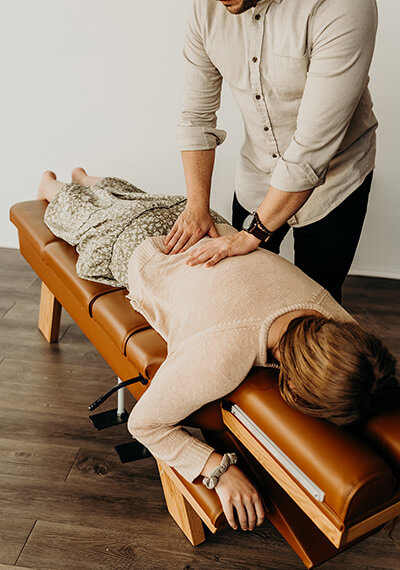
A herniated or bulging disc in Boulder, CO has a way of shrinking your day down to whatever your spine will allow. Bending down to lace up your boots before a hike into the Flatirons, sitting through a full day at a desk, or simply rolling over in bed at two in the morning can set off pain that shoots into a leg, an arm, or settles into your low back and won’t let go. If you’ve been told your only real options are an injection or surgery, there is almost always a non-surgical step worth trying first.
At MŪV Chiropractic we look at a disc as one part of a spine that moves as a whole, not a single broken piece sitting in isolation. That’s usually why herniated disc pain lingers longer than people expect, and why the disc itself isn’t always where a lasting recovery has to start.
What’s Actually Happening in a Herniated or Bulging Disc
Each disc between your vertebrae is built like a small, tough cushion: a fibrous outer ring called the annulus wrapped around a softer, gel-like center called the nucleus. That design lets your spine bend, twist, and absorb shock without the bones grinding on each other.
A bulging disc happens when that outer ring weakens and bows outward under pressure, without tearing. A herniated disc goes a step further: the ring cracks, and some of the gel center pushes through the opening. Either version can narrow the small channel a nerve root travels through, and if the disc material presses on that nerve, you feel it well beyond your spine — down an arm from a neck-level disc, or into a hip, thigh, or foot from a low-back level. The location of the disc, more than the size of the bulge, usually decides which symptoms show up.
What It Feels Like
Disc-related pain rarely stays put in one spot, and it doesn’t always feel like a “back problem” at first. People tend to describe some combination of the following.
- Radiating pain. An ache or sharper, electric pain that travels from the spine down an arm or leg, often worse with certain movements.
- Numbness or tingling. Pins-and-needles sensations in a hand, foot, or fingers along the path of the irritated nerve.
- Weakness. A grip or a leg that suddenly doesn’t feel like it’s pulling its weight, especially on stairs.
- Stiffness and muscle guarding. The muscles around the disc clamp down to protect it, and your motion shrinks fast.
- Pain that shifts with position. Many people feel worse sitting, coughing, or bending forward, and a little better walking.
- One-sided symptoms. Herniations often irritate a nerve root on just one side, favoring one arm or one leg.
One note we take seriously: sudden loss of bowel or bladder control, or fast-spreading weakness in both legs, is a medical emergency and needs an ER, not a chiropractic visit. We always screen for those red-flag signs before we do anything else.
What’s Actually Causing It
Discs herniate and bulge for a mix of reasons, and it’s rarely just one bad moment. Years of repetitive loading add up — long stretches hunched over a laptop, or training loads from trail running, cycling, or ski days without enough recovery. A single awkward lift or an off-balance landing can be the moment the disc finally gives, but it’s usually the last straw on prior wear. Discs also lose water content and elasticity with age, which makes them less forgiving over time.
Here’s the part that surprises people: the disc is often downstream of how the rest of your spine and hips are moving. If a segment above or below the injured disc is stiff, the disc has to absorb more load than it was built to handle. Tight hips, a locked-up mid-back, or old postural habits can all quietly funnel extra stress into one vulnerable level. That’s why we look at the whole chain, not just the level that hurts.
Why Rest and Pills Alone Rarely Settle It for Good
Bed rest and anti-inflammatories can take the edge off a flare, and there’s a place for both short term. But neither changes the mechanical pattern that put extra pressure on the disc in the first place. Once the medication wears off, the same segment is still absorbing more than its share — better for a few days, then right back where you started.
Taking pressure off the injured level, and getting the joints around it moving evenly again, tends to hold up better over time than symptom relief alone. That’s the thinking behind a non-surgical, whole-spine approach rather than treating the disc as something to numb and wait out.
How We Treat Herniated & Bulging Disc
Here’s what we often reach for with a disc problem:
-
Spinal decompression. A slow, controlled stretch that opens space around the disc so it can settle and the nerve stops getting squeezed
-
Chiropractic adjustments. Specific adjustments that restore motion to the segments around the disc so it stops absorbing all the load
-
Soft-tissue work. Hands-on care for the guarded muscles that lock down around an irritated disc
-
Corrective exercise. Movement and positioning work that helps you keep pressure off the disc between visits
What to Expect at Your First Visit
Before we touch anything, we sit down and get the full story of your disc pain — how it began, what makes it better or worse, and what you’ve already tried. From there we do a hands-on exam, and bring in imaging when it will genuinely change the plan, not as a routine box to check. Once we understand what’s driving your symptoms, we build a plan around your specific disc level and the segments feeding into it, adjusting as you progress. Most people feel some shift within the first few weeks.
If you’re deciding whether to come in, our what-to-expect guide walks through the whole process in more detail, and new patients can start with the $99 New Patient Special, which includes the exam and consultation you’d need anyway.
What You Can Do at Home
A few habits can support your recovery between visits, though none of them replace an actual evaluation of what’s going on with your disc.
- Keep moving gently. Short walks and easy range-of-motion tend to help more than strict bed rest.
- Stay hydrated. Discs are largely water, and consistent hydration supports their ability to cushion load.
- Set up your workstation thoughtfully. Monitor height, chair support, and regular position changes reduce sustained load during long desk days.
- Be mindful with lifting. Bend at the hips and knees rather than rounding through the low back, and avoid twisting while lifting.
- Return to activity gradually. Easing back into hiking, running, or the gym in stages gives the disc a chance to adapt.
Frequently Asked Questions About Herniated & Bulging Disc in Boulder
Many people with a herniated or bulging disc find real relief through non-surgical chiropractic care, including spinal decompression and targeted adjustments. It isn’t guaranteed for every case, but it’s often a reasonable first step before considering more invasive options, and we’ll be honest if your case looks like it needs a different level of care.
A bulging disc is the outer ring pushing outward without tearing, while a herniated disc means that ring has cracked and some of the inner gel has pushed through. Both can irritate a nearby nerve and cause similar symptoms, so the label matters less than how the disc is actually behaving.
Not usually. We can often get a good sense of what’s going on from your history and a hands-on exam, and we’ll recommend imaging only if it’s likely to change your plan or if we see red-flag signs. Plenty of people start care and make progress before any imaging is needed.
Spinal decompression is a gentle, controlled stretch designed to take pressure off a compressed disc and nerve, and it’s a common approach for disc-related pain. That said, it isn’t right for every person, which is why we do an exam first rather than starting anyone on a generic protocol.
It varies with how long the disc has been irritated and how much nerve involvement there is, but many people notice some improvement within the first few weeks of consistent care. We adjust the plan based on how you’re actually responding, not a fixed timeline.
If you have sudden loss of bladder or bowel control, rapidly worsening weakness, or numbness in the groin or inner thighs, that needs emergency medical attention right away, not a chiropractic visit. Outside of those red-flag signs, many people move between chiropractic and medical care as part of the same overall plan, and we’re glad to coordinate with your doctor.
A herniated or bulging disc doesn’t have to mean surgery is your only path forward. If you’re ready to find out what’s actually driving your symptoms and build a plan around it, book an appointment with us, or start with the $99 New Patient Special to get your exam and a real plan in place.

 See all on Google