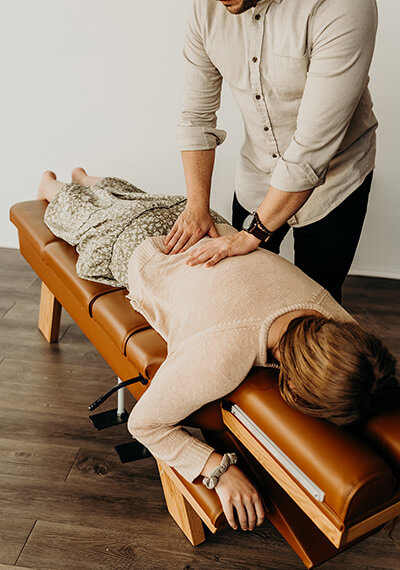
So many people in Boulder, CO are told that pregnancy back pain is just something to grit your teeth through until delivery. It’s incredibly common, but common isn’t the same as inevitable. Most pregnancy back pain has predictable, understandable causes, and those causes respond well to gentle, prenatal-specific chiropractic care.
Whether you’re still walking the Boulder Creek Path most mornings or you’ve traded trail runs for slower strolls around the neighborhood, a sore low back shouldn’t be the thing that decides how your day goes. At MŪV Chiropractic we work with a lot of Boulder mamas-to-be, and we hear the same story often: the ache crept in gradually, nobody told them what was actually happening in their body, and they assumed there was nothing to be done but wait it out. There’s usually more room to feel better than people expect.
What’s happening in your body
Pregnancy asks a lot of your spine and pelvis in a short window of time, and the back pain that shows up is almost always a side effect of real, purposeful changes rather than something going wrong. Early on, your body releases more of a hormone called relaxin, which loosens ligaments throughout the body, especially around the pelvis, so things can shift and expand for a growing baby and, eventually, delivery. That’s necessary, but it means joints that used to feel stable can start to feel looser and less predictable, particularly the sacroiliac, or SI, joints where your pelvis meets your spine.
At the same time, your center of gravity moves forward as your belly grows, and your low-back curve tends to deepen to keep you balanced. Add in the round ligaments, which support your uterus and can stretch sharply with certain movements, and the pubic symphysis joint at the front of the pelvis, which can become tender as the pelvis widens, and you’ve got several sources of strain converging on one area. The low back is often just the loudest voice in a bigger conversation happening across your pelvis and spine.
What it tends to feel like
Pregnancy back pain shows up differently for different people, and it can change from trimester to trimester. Some of the more common patterns we hear about include:
- A deep, achy low back. A dull soreness across the low back that builds through the day and eases somewhat overnight, though not always completely.
- Sharp pain with certain movements. A quick, catching pain when rolling over in bed, standing up from a chair, or getting out of the car, often tied to round ligament or SI joint irritation.
- Pain on one side of the pelvis. Tenderness that sits more to one side, near the back dimple of the hip, which often points toward an SI joint that isn’t moving evenly.
- Tightness across the front of the pelvis. A pulling or grinding feeling near the pubic bone, especially with stairs, getting dressed, or turning over.
- Stiffness first thing in the morning. A back that feels locked up when you first get out of bed and loosens somewhat once you’re moving.
- Radiating discomfort into the hip or thigh. A deep ache that travels beyond the low back itself, which can overlap with sciatica as pregnancy progresses.
What’s actually driving it
It’s tempting to chalk pregnancy back pain up entirely to “the baby’s weight,” but the picture is usually more layered. Ligament laxity from relaxin means your joints rely more heavily on muscles for stability, and if those stabilizing muscles, especially the deep core and glutes, are already fatigued or under-conditioned, the low back and pelvis end up picking up the slack. A forward-shifted center of gravity changes how your spine curves and how weight loads through each step, which can irritate joints that were working fine before. Posture shifts too, as the rib cage flares and the shoulders round forward to balance the growing belly, creating tension that travels down into the low back.
Old asymmetries can resurface as well. A minor pelvic imbalance, an old injury, or a favored side from before pregnancy often becomes more noticeable once ligament laxity sets in. This is why we rarely treat pregnancy back pain as a single, isolated problem — the pelvis, the SI joints, the hips, and the surrounding muscles are usually part of the story, even when the pain itself sits squarely in the low back.
Why rest and pain relievers alone often fall short
It makes sense to reach for rest when something hurts, and rest has its place. But pregnancy back pain is frequently driven by a mechanical issue — an SI joint that isn’t tracking evenly, a pelvis that’s shifted, muscles compensating for new laxity — and lying still doesn’t resolve a mechanical issue. It can even let supporting muscles weaken further, sometimes making things worse once you’re back on your feet. Because so many medications are off the table during pregnancy, many people feel like their options have narrowed to “wait it out” or “push through it.” Neither addresses what’s actually going on in the joint and surrounding tissue, which is part of why the ache can drag on or resurface every time you’re on your feet for a while.
How We Treat Pregnancy Back Pain
Here’s what we often reach for with pregnancy back pain:
-
Webster Technique. Specialized pelvic-balancing work for pregnancy, performed only by Webster-certified, prenatal-trained doctors.
-
Prenatal-appropriate adjustments. Gentle, well-supported technique using pregnancy pillows, side-lying positions, and instrument-assisted options when manual work is uncomfortable.
-
Soft-tissue work. Targeted release for the SI joint, glutes, low-back muscles, and round ligaments.
-
Postural correction. Drills that are safe in every trimester to ease the strain of a shifting center of gravity.
What to expect at your first visit
We keep the first visit relaxed — a real conversation, not a clipboard interrogation. We want to hear how far along you are, where it hurts, and what your goals are, whether that’s getting through your workday comfortably or sleeping through the night without waking up sore. From there we do a gentle, pregnancy-appropriate exam to see how your pelvis, spine, and surrounding muscles are moving. We rely on posture and movement screening rather than X-rays during pregnancy, since imaging isn’t part of safe prenatal care. For a fuller picture of how a visit unfolds, our what to expect at your first visit page walks through it step by step.
From there, we build a plan specific to you, your trimester, and what your body needs right now, and we adjust it as you progress through pregnancy. New patients can also take advantage of our $99 New Patient Special, which includes the visit and exam at a reduced rate.
What you can do at home
Alongside care in the office, a few everyday habits tend to help most people manage pregnancy back pain between visits:
- Move often, in small doses. Short, frequent walks tend to help more than long stretches of sitting or standing still.
- Support your sleep position. A pillow between the knees and one under the belly can take real pressure off the low back and pelvis overnight.
- Watch your workstation setup. Make sure your chair supports your low back and your screen sits at eye level so you’re not slouching forward.
- Stay hydrated. Well-hydrated tissue tends to tolerate the demands of pregnancy better than tissue that’s running dry.
- Load your body gradually. If you’re still active, ease into effort rather than pushing hard on a day when your back already feels tender.
Frequently Asked Questions about Pregnancy Back Pain in Boulder
Generally, yes. Prenatal chiropractic care uses gentle, pregnancy-specific techniques and positioning built around your changing body, and it’s a widely used option for many pregnant patients. That said, every pregnancy is different, and we always coordinate with your OB or midwife, especially if you have a higher-risk pregnancy.
Many pregnant patients find real relief from gentle, prenatal-focused chiropractic care, especially when the pain is tied to pelvic or SI joint imbalance. We can’t promise a specific outcome, since every pregnancy responds differently, but it’s often worth an evaluation to see what’s driving your particular pain.
The Webster Technique is a specific, gentle method for balancing the pelvis during pregnancy, performed by doctors with additional Webster certification and prenatal training. Not every pregnant patient needs it, but for pelvic and SI-related back pain, it’s frequently part of the plan we build together.
It varies by person and by trimester, but many people notice at least some improvement within the first few weeks of consistent care. Because your body keeps changing throughout pregnancy, care often continues in some form until delivery rather than wrapping up after a set number of visits.
Yes, and that’s intentional. What feels comfortable and appropriate in the first trimester looks different by the third, so we reassess regularly and adjust positioning, technique, and frequency as your body and your baby grow.
New patients can start with our $99 New Patient Special, which covers your first visit and exam. From there, we’ll talk through recommendations and costs before you commit to anything further.
Pregnancy back pain is common, but you don’t have to just live with it until your due date. If you’re ready to feel more like yourself again, book an appointment or take advantage of the $99 New Patient Special to get started with a plan built for exactly where you are in your pregnancy.

 See all on Google