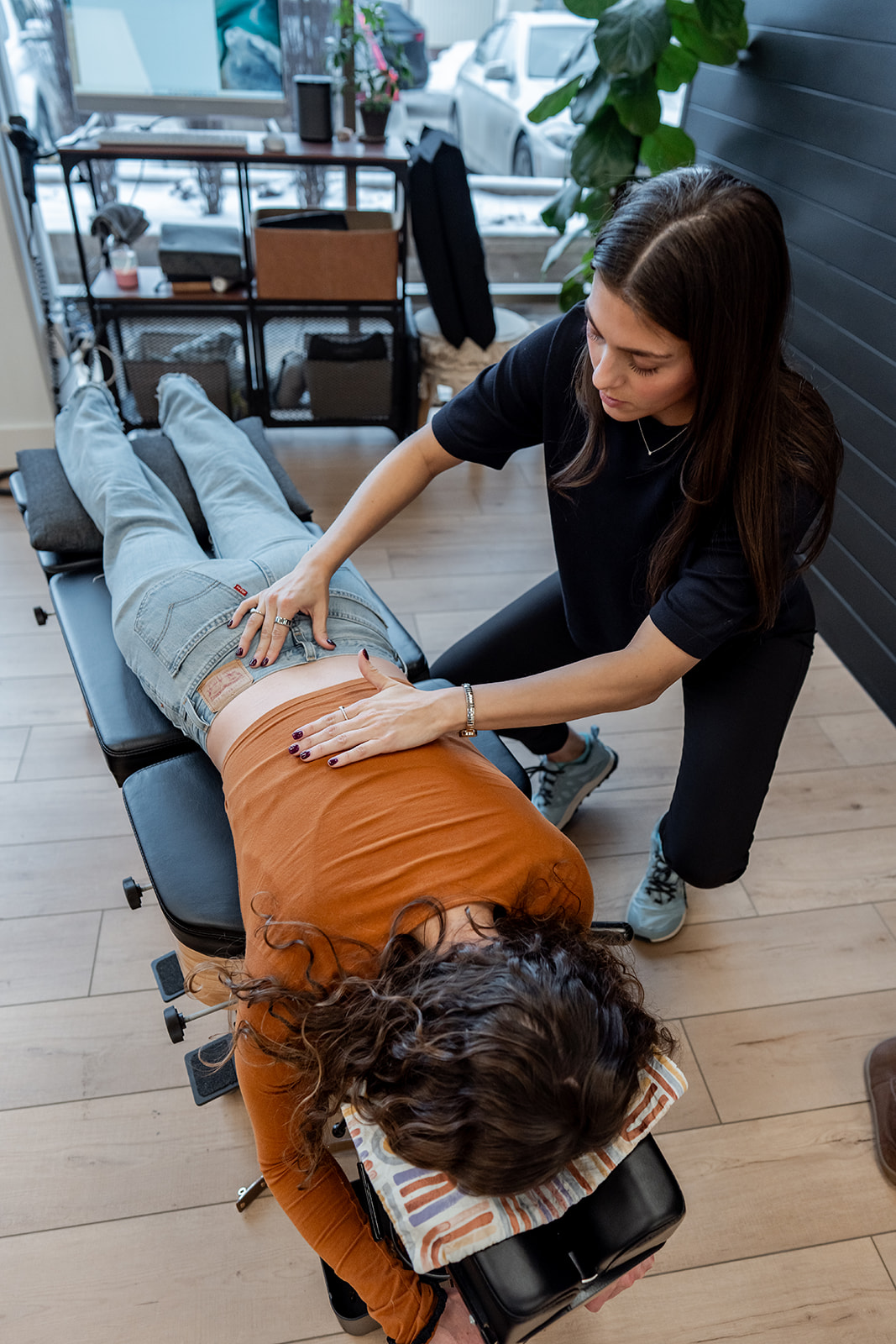
Text neck / tech neck in Boulder, CO shows up in a lot of the same places you’d expect: hunched over a laptop at a coffee shop on Pearl Street, scrolling on the bus up to CU Boulder, or answering one more email before closing the computer for the night. We spend hours a day looking down at something, and the body quietly rearranges itself around wherever it spends the most time. For a lot of people, that rearrangement shows up as a stiff, achy neck and a set of rounded shoulders that don’t unwind on their own.
At MŪV Chiropractic we see this constantly, in remote workers, students, and weekend athletes alike. The pattern doesn’t discriminate between a desk job and a trail-running habit — if your days involve a screen, your neck is doing extra work. The encouraging part: this is a mechanical pattern your body learned, which means it’s also one it can unlearn with the right care and habit changes.
What’s actually happening in your neck
Your head is heavy, roughly the weight of a bowling ball, and your cervical spine is built to balance that weight directly over your shoulders. When you tip your chin down to look at a phone or lean toward a laptop screen, the head moves forward of that balance point. The farther forward it drifts, the more leverage gravity gets, and the harder the muscles at the back of your neck and top of your shoulders have to work just to hold your head up.
Do that for a few hours a day, every day, for years, and the tissues adapt to the new normal. The neck’s natural forward curve can flatten out, and the joints in the upper neck and mid-back stiffen in the positions you hold most often. Muscles that should stay relaxed stay switched on instead, while the muscles that should hold you upright go quiet from disuse. None of this happens because of one bad day at your desk — it builds slowly, which is part of why it’s easy to ignore until it isn’t.
What text neck feels like day to day
Text neck rarely announces itself as one dramatic injury. It tends to creep in as a collection of small, familiar complaints:
- A stiff, achy neck that’s worst at the end of a workday or after a long stretch of scrolling.
- Tight upper traps and shoulders that feel like they’re carrying tension even when you’re trying to relax.
- Headaches that start at the base of the skull and spread up over the top of the head.
- A rounded, hunched upper back that makes standing up straight feel effortful rather than natural.
- Jaw tightness or clicking, since a forward head position changes how your jaw sits and loads.
- Reduced neck rotation, noticeable when you check a blind spot or turn to talk to someone beside you.
What’s actually driving it
The obvious culprit is screen time, but the full picture is usually a little more layered. Remote and hybrid work has put more people in front of laptops for longer stretches, often on a couch or kitchen table without any real ergonomic setup. Phones make it worse in a different way: a phone held low in the lap or at waist height pulls the head into a steeper forward angle than even a poorly positioned monitor does.
Beyond the hours themselves, a few other things tend to feed the pattern. Stress makes people round their shoulders and brace, layering extra tension on top of the postural strain. A sedentary day with little movement lets stiffness settle into joints that would otherwise stay mobile. And for a lot of people, one side of the body works harder than the other — a phone always cradled on the same shoulder, a mouse used with the same arm all day — which turns a symmetric problem into a lopsided one.
This is why we look at more than just the neck itself. The neck is rarely the whole story; it’s usually the part of the chain that’s been asked to compensate the longest. A stiff mid-back, a tight chest, and weak postural muscles between the shoulder blades all play a role in how much strain lands on the neck itself.
Why it keeps coming back even after it feels better
This is the part that frustrates a lot of people: the neck loosens up over the weekend, and by Wednesday afternoon it’s tight again. That’s not bad luck. A hot pack, a massage, or an over-the-counter pain reliever addresses the discomfort of the moment without touching the posture that’s recreating it. If the joints in your neck and upper back are still stiff and your postural muscles are still deconditioned, your body falls right back into the position it’s rehearsed the most, and the tension returns with it.
Rest has a similar limit — most people can’t take a permanent day off from screens, and the pattern is waiting the moment you pick the phone back up. Lasting change usually needs a few things working together: getting the stiff segments of the spine moving again, re-training the postural muscles that have gone quiet, and adjusting daily habits like desk height, phone position, and break frequency so the strain isn’t rebuilt every afternoon.
How We Treat Text Neck / Tech Neck
Here’s what we often reach for with text neck:
-
Cervical adjustments. Focused work to free up the stiff neck, upper-back, and rib joints where the pattern piles up
-
Soft-tissue work. Targeted release for the upper traps, levator scapulae, suboccipitals, and tight chest muscles
-
Corrective exercise. A step-by-step program that wakes up the postural muscles and rebuilds the position over time
-
Postural correction. Workstation and screen-habit guidance so the gains hold up between visits
What to expect at your first visit
We lead your first visit with conversation, not a script. We want to know about your work setup, how many hours you’re on a screen, and where the discomfort actually sits. From there we do a hands-on exam and a postural screening, so we have an honest baseline of where your neck and upper back are starting from. Imaging comes into play when it would actually change the plan, not as a routine step for every patient.
Once we understand what’s going on, we build a plan around your neck, your upper back, and the postural habits that feed the pattern, and we adjust that plan as you progress. If you’re not sure what a first visit looks like, our what to expect on your first visit page walks through it in more detail.
What you can do at home
Care in the office matters, but so does what you do the other twenty-three hours of the day. A few habits tend to help most people with text neck:
- Bring the screen to eye level. Prop up your laptop, or at least glance at it instead of tipping your whole head down for hours at a time.
- Hold your phone higher. Bringing it closer to eye level, even briefly, takes real load off the back of your neck.
- Take movement breaks. Standing up, rolling your shoulders, and looking around the room every thirty to sixty minutes keeps joints from stiffening in one position.
- Stay hydrated. Well-hydrated soft tissue tends to tolerate load and stress better than dehydrated tissue.
- Build up postural strength gradually. Gentle, consistent work for the muscles between your shoulder blades tends to hold up better than sporadic bursts of exercise.
Frequently Asked Questions about Text Neck / Tech Neck in Boulder
Many people find real relief when the stiff joints in the neck and upper back are addressed alongside the postural habits that caused the problem in the first place. It’s rarely a single fix, but combining hands-on care with better daily habits tends to work better than either one alone.
It varies by person, how long the pattern has been building, and how consistent you are with the home habits. Many people notice a shift within the first few weeks, though a pattern that’s been years in the making usually takes more than a couple of visits to fully settle.
No. You can schedule directly with us. If we think you’d also benefit from another provider, we’ll let you know and help coordinate that care.
For most people, yes. We start every new patient with a conversation and an exam so we understand your history before recommending anything, and we adjust the plan based on what we find.
Stretching can offer temporary relief, but it usually doesn’t address the stiff joints or the weak postural muscles underneath the tightness. Most people need a combination of hands-on work, postural retraining, and habit changes for the improvement to actually stick.
New patients can start with our $99 New Patient Special, which includes the exam and consultation where we take a baseline of your posture and neck before recommending a plan.
Text neck built up gradually, and it usually eases the same way — a little at a time, with the right combination of care and habits. If your neck, shoulders, or head feel like they’re always fighting gravity, we’d like to help you figure out why. Book an appointment or take advantage of our $99 New Patient Special to get started.
Learn about our chiropractic care →

 See all on Google