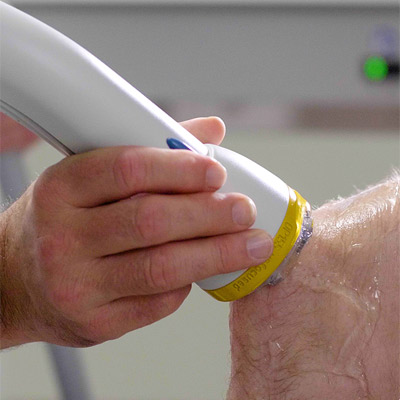
If a stubborn heel, elbow, or shoulder has you searching for options beyond rest and ibuprofen, you have probably run into the term SoftWave therapy and wondered what it actually is. The short version: SoftWave is a brand of acoustic wave treatment, a close relative of the extracorporeal shockwave therapy that researchers have studied for decades in chronic tendon and soft-tissue pain. At MŪV Chiropractic Health Center in Boulder, it is one of the advanced therapies we offer alongside chiropractic care, and one of the treatments patients ask about most. Here is a plain-language look at how it works, what a session feels like, what the research supports, and who it is (and is not) a fit for.
What is SoftWave therapy?
SoftWave therapy is a non-invasive treatment that delivers broad, unfocused acoustic pressure waves into painful or injured tissue through a handheld applicator. The device generates the waves electrohydraulically, using a small spark inside a fluid-filled head, and spreads them across a wide region of tissue instead of concentrating them at a single point.
Those waves create a brief mechanical stimulus that cells respond to, a process researchers call mechanotransduction. Studies of shockwave therapy suggest this stimulus can increase local blood flow and activate the body’s own repair processes in the treated tissue. In practical terms, the goal is to calm chronic irritation and support healing in tissue that has stalled, without needles, medication, or downtime.
If you want more detail on the device and protocol we use, our SoftWave tissue regeneration therapy page covers it in depth.
Is SoftWave the same as shockwave therapy?
Essentially, yes. SoftWave belongs to the family of treatments called extracorporeal shockwave therapy (ESWT), which is where most of the published research lives. The differences are in how the energy is delivered:
- Focused shockwave devices concentrate energy at a precise depth, which can be intense enough that some protocols use numbing cream.
- Radial pressure wave devices push energy outward from the skin surface, and the effect drops off quickly with depth.
- SoftWave uses an unfocused, parallel wave that spreads energy across a broader and deeper region at a lower peak pressure, which most patients find quite tolerable.
That family relationship matters when you read about evidence. Most studies test shockwave therapy in one form or another, and findings from that larger body of research are commonly applied to SoftWave, even though independent research on SoftWave’s specific wave format is still building.
What does a SoftWave session feel like?
A session is much simpler than the physics behind it. Your provider applies ultrasound gel to the area, then moves the applicator across the tissue while it delivers rhythmic pulses. Most patients describe the sensation as firm, fast tapping. The pulses tend to feel most noticeable directly over irritated tissue, which is actually useful: it helps us map precisely where treatment should focus.
A typical treatment takes roughly 10 to 15 minutes. There is no anesthesia and no recovery period; most people drive themselves home and go about their day. Some notice temporary soreness or mild redness in the treated area afterward, similar to a thorough deep-tissue session. Plans vary by condition, but care usually involves a short series of sessions spaced over several weeks rather than a single visit.
What do people use SoftWave therapy for?
SoftWave is used for musculoskeletal complaints, particularly the chronic, slow-to-heal kind. At MŪV, the most common reasons Boulder patients ask about it include:
- Plantar fasciitis and heel pain that flares with the first steps of the morning
- Achilles and patellar tendon pain in runners, hikers, and climbers
- Tennis elbow and golfer’s elbow
- Rotator cuff irritation and general shoulder pain
- Knee pain, including as part of our Knee Restoration Program
- Chronic muscle tightness and trigger points in the back, hips, and neck
Boulder is full of runners, cyclists, and climbers, so tendon overuse injuries are practically a local specialty. These are exactly the complaints where a treatment aimed at the tissue itself, not just the symptom, makes clinical sense.
What does the research actually say?
The honest answer: encouraging for several conditions, still emerging for others.
Shockwave therapy is one of the better-studied non-surgical options for chronic tendon and fascia problems. Systematic reviews and meta-analyses of ESWT for chronic plantar fasciitis have found meaningful reductions in pain and improvements in function for many patients, with a good safety profile. Research on chronic tendinopathies, including tennis elbow and calcific rotator cuff tendinopathy, has also reported benefit for a substantial share of patients, and shockwave appears in a number of clinical guidelines as a conservative option when first-line care has not been enough.
A few honest caveats belong here. Study protocols vary widely in device type, energy level, and number of sessions, so results differ across trials. Much of the published research covers focused and radial shockwave devices; independent studies of SoftWave’s specific unfocused format are newer and still accumulating. And no trial shows shockwave working for everyone: a meaningful share of patients respond well, and some do not.
That is why MŪV frames SoftWave as a well-tolerated, evidence-informed option for stubborn soft-tissue pain, and why we re-measure your progress during care so we know whether it is earning its place in your plan.
Who should not get SoftWave therapy?
SoftWave is considered low-risk for most people, but it is not for everyone. Providers generally avoid treating:
- Over or near an area of active cancer
- During pregnancy, over or near the abdomen and low back
- People with certain bleeding disorders, or those taking blood-thinning medication, without medical clearance
- Directly over an active infection or open wound
- Over growth plates in children and adolescents, in most protocols
It is also not a replacement for a diagnosis. Heel or shoulder pain can occasionally signal a problem that needs medical workup first, which is exactly why treatment at MŪV never starts with the machine.
How does MŪV use SoftWave alongside chiropractic care?
Every new patient at MŪV starts with what we believe is the most detailed exam in Boulder: a thorough history, digital posture screening, X-ray analysis when indicated, and a clear report of findings before any care begins. That matters for SoftWave specifically, because acoustic waves are only useful when they are pointed at the actual problem. Heel pain that traces to the plantar fascia is a good SoftWave candidate; heel pain that traces to how your low back and gait are loading the foot may need adjustments, decompression, or both.
Drs. Travis Stewart and Mike Lynch, who bring more than 20 years of combined experience, typically use SoftWave as one tool inside a broader plan: adjustments to restore joint motion, spinal decompression where disc-related pain calls for it, and SoftWave therapy where irritated soft tissue needs a direct push toward healing. Progress gets re-measured along the way, so decisions rest on data instead of hope.
Frequently asked questions about SoftWave therapy
How many SoftWave treatment sessions will I need?
It depends on the condition, how long it has been present, and how your tissue responds. Many SoftWave treatment plans involve a short series of sessions spaced over several weeks, and your plan at MŪV is set after your exam and adjusted based on measured progress, never pulled from a template. [NOTE: confirm typical session-count range with client]
Does SoftWave therapy hurt?
Most patients find it very tolerable. The pulses feel like brisk tapping and are most noticeable over irritated tissue. If a spot is too tender, your provider can adjust the intensity or position. No numbing is needed, and any post-session soreness usually fades within a day or two.
What do SoftWave therapy reviews say?
Patient reviews of SoftWave therapy, at MŪV and elsewhere, commonly describe reduced pain and easier movement over a course of care, especially for heel, elbow, and shoulder complaints. Reviews are individual experiences, though, and results vary from person to person. MŪV’s care overall has earned more than 700 five-star Google reviews, which say more than any single testimonial could.
Is SoftWave therapy covered by insurance?
Usually not; most insurers still classify shockwave-type therapies as elective. Our front desk can walk you through current pricing and package options when you book. [NOTE: confirm current billing and insurance guidance with client]
Is SoftWave the same as laser or ultrasound therapy?
No. Laser therapy uses light energy, and therapeutic ultrasound uses high-frequency sound that primarily warms tissue. SoftWave delivers acoustic pressure waves that mechanically stimulate cells. They are different technologies with different bodies of research behind them.
Curious whether SoftWave could help? Start with the exam
If a nagging tendon or joint has been limiting your runs, rides, or workdays, the fastest way to find out whether SoftWave belongs in your plan is a proper evaluation. Book online, claim the $99 new-patient special, or call (720) 636-6064. MŪV Chiropractic Health Center is at 1790 30th St #100 in Boulder, and you will get a straight answer about what we find, including when SoftWave is not the right tool.
 See all on Google